Advoca is a migraine tracking app built by doctors. Journal attacks, triggers and medications in plain language, record your neurology appointments, and arrive at every consultation with a real record behind you, so the conversation starts from evidence, not memory.
Migraine is a recurrent neurological condition, not simply a bad headache. A typical attack brings moderate-to-severe, often one-sided, pulsating head pain that worsens with routine movement, and is usually accompanied by nausea and sensitivity to light (photophobia) and sound (phonophobia). Attacks last anywhere from four hours to three days. Around one in three people with migraine also experience aura: reversible visual or sensory changes that can precede the pain.
Migraine often begins at puberty, is most active between the ages of 35 and 45, and is more common in women, partly for hormonal reasons. It is usually lifelong and episodic. Attacks can be set off by factors such as sleep disruption, alcohol and certain foods, though triggers are individual and multifactorial, and identifying your own usually takes a record kept over time.
Beyond the pain itself, migraine carries a hidden burden. The postdrome that follows an attack can leave fatigue and brain fog for a day or two, and lost work and social days add up. Yet because attacks happen between appointments, much of this stays invisible to the people trying to help. A clinician typically sees you for a fraction of your migraine life, which is why a record kept between visits matters.
Migraine affects around 1 in 5 women and 1 in 15 men, making it one of the most common neurological conditions and a leading cause of disability worldwide.
Migraine happens between appointments, and memory isn't enough
Most of your migraine life happens out of a clinician's sight. An attack at 3pm on a Tuesday, the triptan you took, the missed work, the photophobia that frightened you: by the time you reach a 15-minute follow-up weeks later, the detail has blurred. Triggers go unexamined, side effects go unmentioned, and the appointment moves on before you have remembered what you meant to ask. Add in the jargon (gepants, CGRP, medication-overuse headache), and it is easy to leave a neurology consultation more confused than you arrived.
WHY TRACKING HELPS
Keeping a record changes the picture.
Keeping a record changes that. A headache calendar is one of the simple, effective interventions the World Health Organization names for identifying triggers and reviewing treatment. Advoca was built so that record is easy to keep and genuinely useful at the point of consultation: you journal attacks in plain language as they happen, record your appointments so nothing is lost, and walk in with a real summary instead of a vague memory. Nothing here diagnoses migraine or replaces your doctor. It gives you and your clinician something solid to look at together.
HOW ADVOCA HELPS
How Advoca helps with migraine
Journal your attacks
Track attacks and possible triggers in your own words
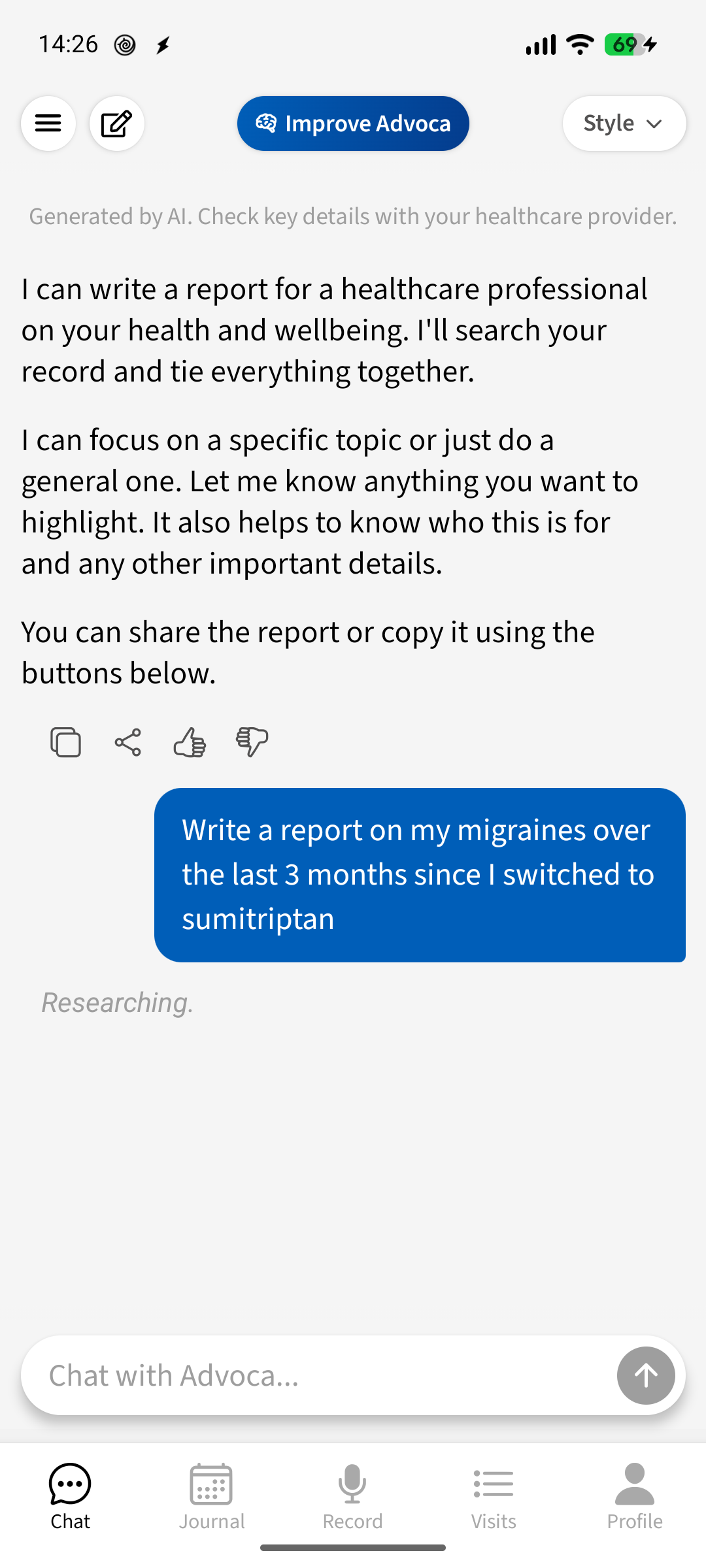
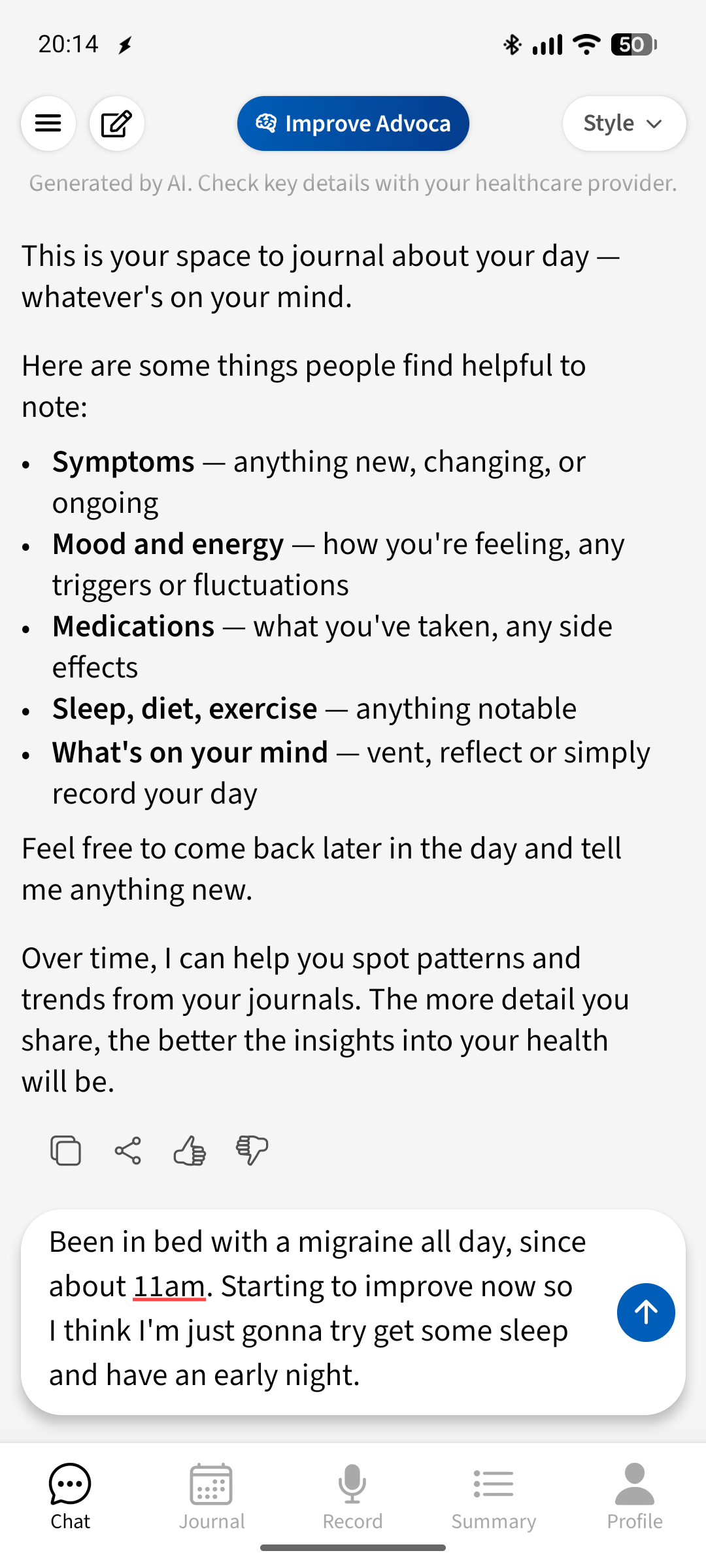
Migraine triggers are different for everyone, and spotting your own takes time. With Advoca you don't fill in a rigid form. You just write your day the way it happened: 'slept badly, skipped lunch, stress at work, attack at 3pm, in bed all day', by typing or chatting. Over time you can ask what your entries show, like whether there's a pattern to your migraines this month, and get an answer drawn from your own words.
Write it your way. Capture attacks, symptoms, sleep and medication as they happen, by typing or chatting.
Ask your record a question, like 'Is there a pattern to my migraines this month?', and get an answer from your own entries.
Record your neurology consult
Record the appointment, get a summary you actually understand
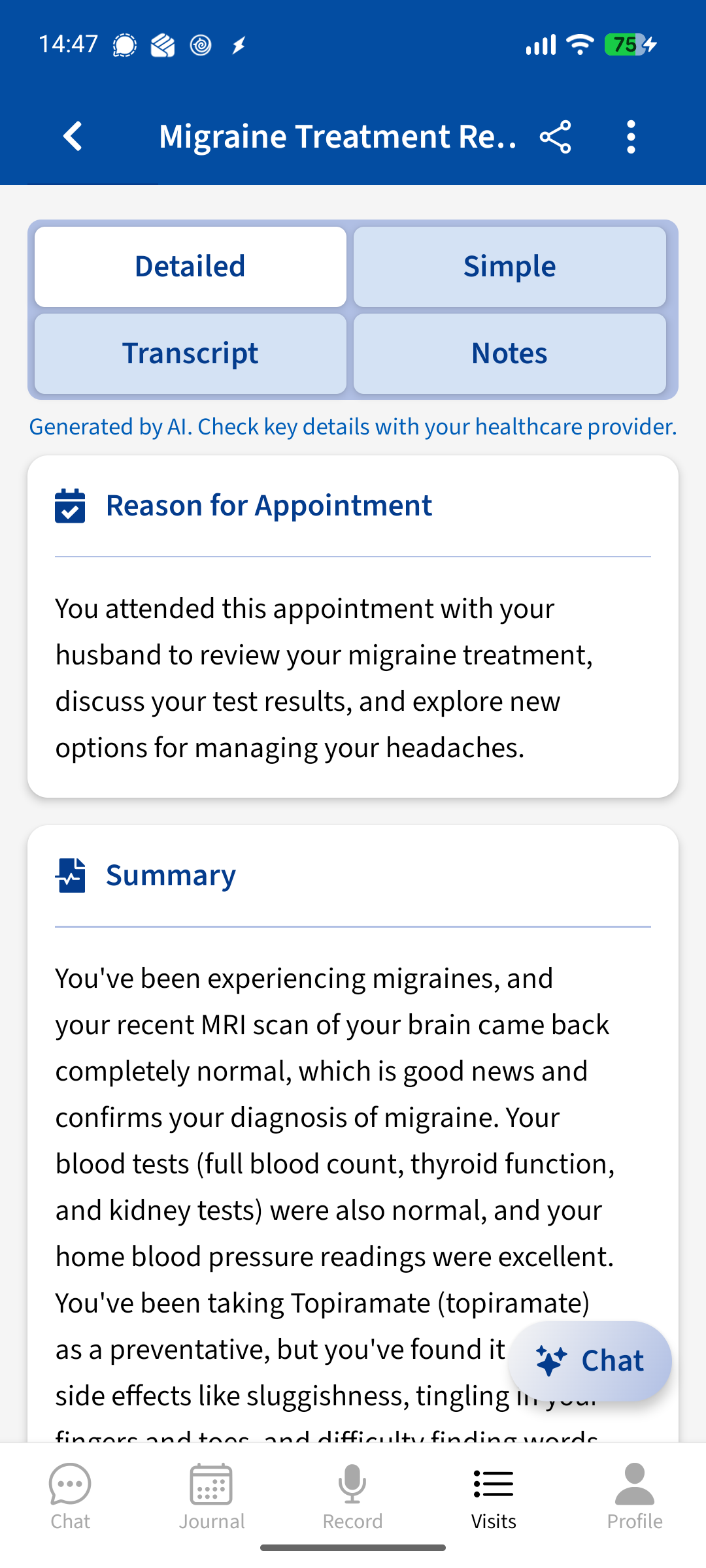
A neurology appointment covers a lot in fifteen minutes: a new medication, whether to change your dose, what to try next. And the words don't always land the first time. Record it on your phone and Advoca turns it into a clear summary you can read at your own pace, with the full transcript saved alongside. Any medical term is explained in plain language, and if a dose or number looks off, it's flagged so you can check. Need it simpler? One tap gives you a plain-English version.
A clear summary, not a wall of notes. The key points and next steps, with the full transcript always there if you want it.
No more medical jargon. Terms are explained in plain language, and anything that looks like a wrong dose or number is flagged to check.
Ask your questions
Ask about your treatment, get clear answers
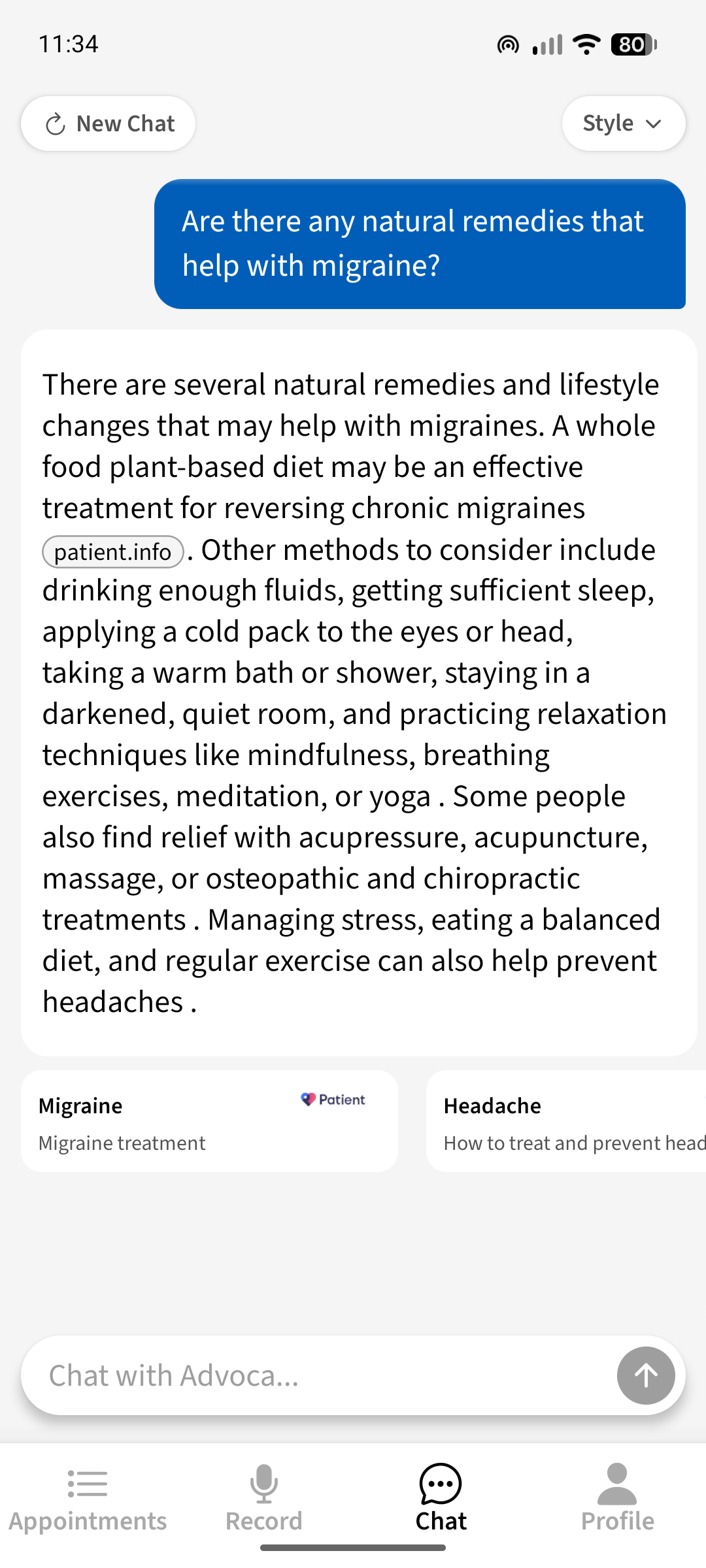
Wondering whether light sensitivity is normal with migraine, or what the difference is between two medications? Just ask. Advoca answers from trusted charities, patient-information sites and medical sources (not the open web), and shows you where each answer came from so you can check for yourself. Think of it as a starting point for reading and a question to bring to your doctor, not personal medical advice.
Answers from sources you can trust: charities, patient-information sites and medical bodies, not the open web.
See where it came from. Every answer shows its sources, so you can check for yourself.
Plan your follow-up
Walk into the follow-up with a prepared agenda
Follow-ups are short, and migraine fog makes it easy to forget the side effect or medication question you meant to raise. Before the visit, jot down what you want to cover. Advoca can pull together a short list from your recent entries and your last appointment, like 'how is the topiramate working, and what about the side effects?'. Those notes are right there the moment you start recording, so nothing slips through. You can also share a summary of a past visit with a carer, or bring one to your next appointment.
Go in with a plan. Advoca drafts a short list of what to cover, from your recent entries and last visit.
Nothing forgotten. Your notes appear the moment you start recording, and you can share a visit summary with a carer.
HOW IT WORKS
From attack to understood in three steps
1Journal the attackWhen an attack hits, just write what happened: the symptoms, what you think triggered it, the medication you took, how it affected your day. Type it or say it. There's no form to fill in.
2Record and understand the consultRecord your neurology or doctor's appointment on your phone. Advoca turns it into a clear summary you can read at your own pace, with any medical term explained in plain language.
3Arrive prepared next timeBefore the next visit, ask Advoca to draft a short list of what to cover, from your recent entries and last appointment. Share a summary with a carer or your clinician, so the conversation starts from a real record, not a vague memory.
REAL PATIENT STORIES
See how Advoca helps people
Real video stories from people using Advoca to understand their care and feel less alone with their health.
Video story
Coral @cookiemonster3302
Living with Chronic illness and FND
“Record the conversation so you never have to worry about forgetting anything again.”
Are you tired of feeling like this after your appointment? Oh my goodness. What did they say? What do I have to do again? What medication am I taking again? What did they say? I want you to call someone with me. Don't worry, girly. I got you. Have you heard of this new app called Advocat? Advocat is basically an app where you can, on your doctor's appointments, record the conversation so you never have to worry about forgetting anything again. Wait, what? That's amazing. So I never have to worry about remembering anything from a doctor's appointment again? And as long as I tell them that I'm recording, it's perfectly fine? Exactly that. It is super simple. Wow. All you do. So you click on your Advocat app and once it opened with Face ID, it will go to your profile. You fill out all of your medical information. After that, you press the record button and it will come up with what you have to do. You want to see what you've recorded. You go into appointments and there's your information. So if you've got a phone call coming through, all you have to do is just press the record button on the normal phone and then it will send it to your notes app and then you just transfer it from your notes app recordings to your Advocat app. And there you go. All of your information is stored in the Advocat app. You can never be gaslit again and you never have to worry about taking anyone again. You're welcome.
Video story
Jade @chronicallyiconicx
Living with Chronic illness
“It has made me feel so much more confident going into appointments.”
We all know being chronically ill comes with multiple doctor's appointments, seeing different consultants for different things, and it can be so hard to keep up with all the information that's said. Quite often there are important details we miss, and a normal recording doesn't break down the key points of the conversation. But I recently came across an app called Advocat, and it's completely changed how I manage my appointments. With Advocat, you can record your doctor's appointments, and the app generates a clear summary that focuses on the most important information mentioned. No more replaying long recordings and trying to figure out what actually mattered. It also pinpoints any medication mentioned and gives you information about it, plus shares helpful resources about any conditions discussed. You can set reminders for upcoming appointments so you don 't forget anything, and write down questions you want to ask beforehand, and the app will remind you during your appointments. You can even transfer full-time recordings into the app to keep a full log of all your medical conversations. I am so glad I found this app, and it's made me feel so much more confident going into appointments. And now I've got all the important information I need, and stored easy to come back to. And the best part about it is, it is completely free and always will be. If you struggle keeping track of everything like I do, I honestly couldn't recommend it more. Go and download Advocat and try it for yourself. Take the stress out of managing your appointments.
In their words
People using Advoca to make symptoms easier to explain
It describes my daily experiences.
— Carrie, lives with POTS, hEDS and migraine
I’ve been using it for four days and I already would be lost without it… it helped me work out symptoms and prepare for medical appointments.
— Jayne, lives with adrenal-crisis risk
Daily written summaries make it much easier to organise your thoughts… symptoms, concerns and questions stay in one place.
— Jake, lives with ongoing/complex health conditions
Reviewed by doctors
Built by doctors, grounded in evidence
This page was written by Dr Shyam Dhokia (MB BChir, Cambridge) and medically reviewed by Dr Michael Trueman (MB ChB, Birmingham), both former NHS doctors and the co-founders of Advoca. It was last reviewed on 7 July 2026 and is kept current as clinical guidance and app features change.
Your data is encrypted in transit and held on encrypted servers in the UK and EU, served over HTTPS. You don't need to share any identifying details to use Advoca, and appointment recordings stay on your own device — the audio is never uploaded to our servers.
Medical disclaimer
Advoca helps you record, understand and organise your care. It is not a substitute for professional medical advice, and it does not diagnose conditions or make treatment decisions — always speak to a qualified healthcare professional.
How the AI works
Advoca's assistant transcribes, summarises and explains your health information, grounded in trusted medical sources and overseen by our clinical team. It does not diagnose or replace your doctor — and, like any AI, it can occasionally get things wrong, so we always show you the sources and full transcript behind its answers.
Your questions, answered
What is migraine?
Migraine is a recurrent primary headache disorder, not just a bad headache. A typical attack lasts 4 to 72 hours and brings moderate-to-severe, often one-sided, pulsating head pain that worsens with movement, plus nausea and sensitivity to light and sound. Around one in three people with migraine also experience aura: reversible visual or sensory changes before the pain. Migraine often begins at puberty, is most active between 35 and 45, is more common in women, and is usually lifelong and episodic. The exact cause isn't known, though it is thought to involve inflammatory substances around the nerves and blood vessels of the head. Diagnosis is clinical, made by a doctor or neurologist from your history and attack pattern. Sources:NHS, UK; NINDS, US (NIH); WHO.
What's the best app for migraines?
The best migraine app depends on what you need it to do. Advoca is built for the whole cycle, not just attack logging: you journal attacks and possible triggers in plain language, record your neurology appointments and get a plain-language summary, ask grounded questions about your treatments, and arrive at follow-ups with a drafted agenda. The honest limitation: Advoca does not yet offer the structured migraine-specific attack charts and trend graphs that dedicated migraine logging apps have. Structured charts from journal data are on the roadmap. Today its strength is AI reasoning over your free-text record and the record-to-chat-to-consultation loop. Advoca does not diagnose migraine or replace your doctor.
What triggers migraines?
Commonly reported triggers include sleep disruption, alcohol, certain foods, stress and hormonal changes, but triggers are individual and multifactorial. A trigger is not a deterministic cause, and identifying your own usually takes a record kept over time. The World Health Organization lists using a headache calendar to identify triggers as one of the simple, effective interventions for headache disorders. Advoca lets you journal attacks and possible triggers in plain language as they happen, so you and your doctor can look for patterns in your own data. The app surfaces those patterns for you both to interpret; it does not diagnose your triggers causally. Sources:NHS, UK; NINDS, US (NIH); WHO.
What is medication-overuse headache?
Medication-overuse headache (MOH) is a secondary headache disorder caused by frequent use of acute medication to treat headache. The World Health Organization lists it as the most common secondary headache disorder, potentially affecting up to 5% of some populations, with women affected more than men. It is defined by acute-medication use on more days than not over three months. Because MOH is defined by how often you take acute medication, a record of your medication days is central to spotting it. Advoca does not diagnose MOH; it keeps an honest record of acute-medication days for you and your doctor to review together. Sources:NHS, UK; NINDS, US (NIH); WHO.
How is migraine diagnosed?
Migraine is diagnosed clinically, by a doctor or neurologist, based on your history and the pattern of your attacks, not by a scan or a blood test. Neuroimaging such as an MRI is typically used only to rule out other causes when something in your history suggests it. An attack is usually classed as migraine if it has features such as one-sided, pulsating pain of moderate to severe intensity, lasting 4 to 72 hours, with nausea or sensitivity to light and sound. Keeping a record of your attacks, symptoms and medication use helps you give an accurate history at that appointment. Advoca does not diagnose migraine or rule out secondary causes; that is for your clinician. Sources:NHS, UK; NINDS, US (NIH); NICE, UK.
Can an app help with migraines?
An app can help you keep a record of your attacks, symptoms, possible triggers and medication use, and bring that record to your consultations. The World Health Organization names a headache calendar as one of the simple, effective interventions for headache disorders, because a record kept over time helps you and your doctor identify triggers and review treatment. Advoca goes further than a calendar: it lets you journal in plain language, record and summarise your neurology appointments, ask grounded questions about your treatments, and draft a follow-up agenda. It does not diagnose migraine, give personal treatment advice, or replace your doctor, and no app should be used to replace clinical care. Sources:NHS, UK; NINDS, US (NIH); WHO.
EXPLORE MORE
Explore related conditions and features
Advoca can support you across other long-term conditions, and the features that help you manage them.