Cancer Support App

Advoca is a cancer support app built by doctors. Record your oncology appointments and get a summary you can actually understand, journal side effects in your own words, ask grounded questions with sources shown, and arrive at every consultation with a real record behind you.

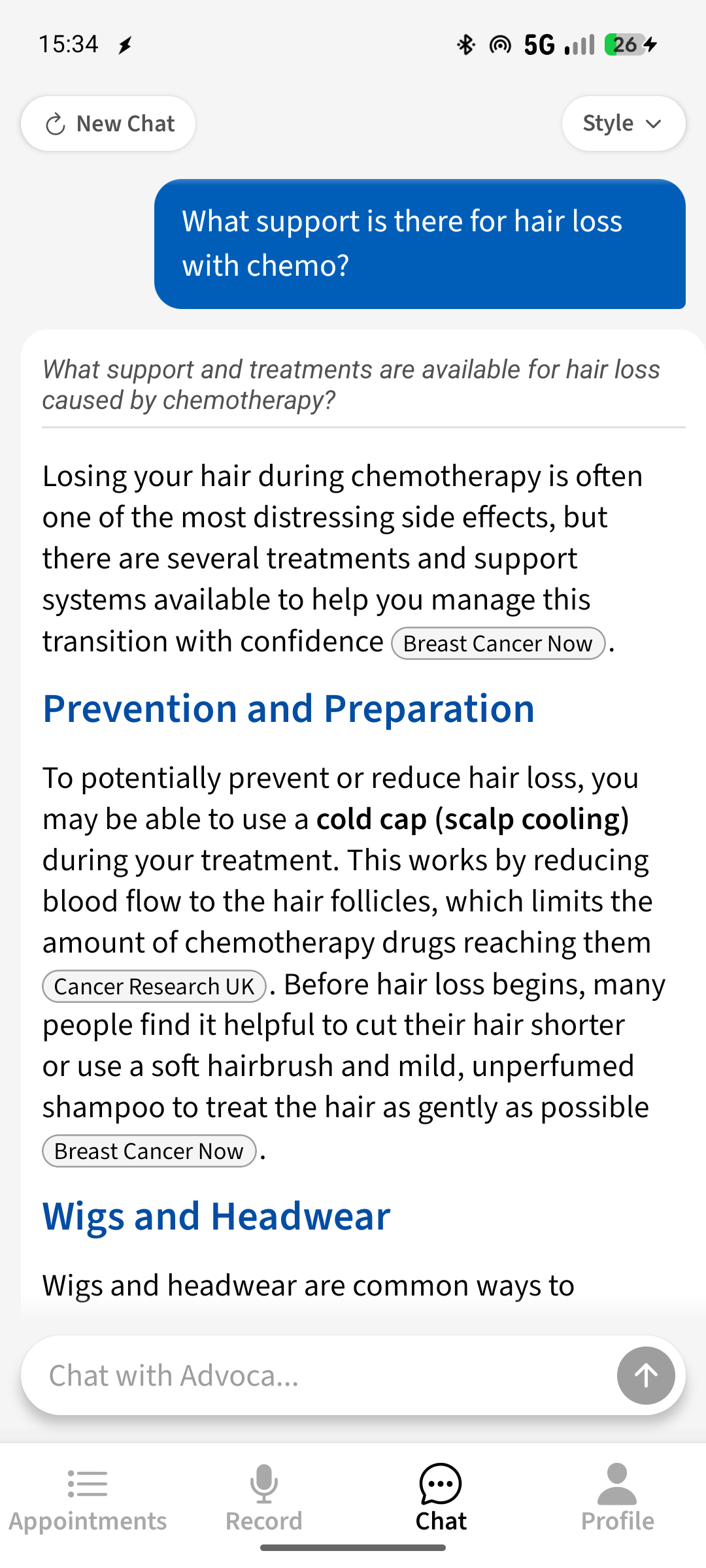
Advoca answering a breast cancer question about chemotherapy, hair loss, cold caps and wigs, with source cards shown
Download on the App StoreGet it on Google Play4.8 across 35 ratings
Built by NHS doctors Free to use GDPR compliant & HIPAA aligned
Written by Dr Shyam Dhokia, MB BChir Reviewed by Dr Michael Trueman, MB ChB Last reviewed
Understanding cancer

Cancer: more than one disease

Cancer is not a single illness but a large group of diseases that can affect almost any part of the body. Its defining feature is the rapid growth of abnormal cells that multiply beyond their usual boundaries, can invade neighbouring tissue, and may spread to other organs, a process called metastasis. A malignant tumour can spread; a benign tumour stays in one place and does not, though both need a doctor's assessment.

Cancer is common. Globally, about one in five people develop it in their lifetime, and it is a leading cause of death worldwide. It becomes more common with age, though it can occur at any stage of life. There are many types, from solid tumours such as breast, lung, bowel and prostate cancer to blood cancers such as leukaemia and lymphoma, and each has its own behaviour, treatment and outlook.

Cancer care typically moves through diagnosis, staging (working out how far the disease extends), treatment planning, active treatment, and follow-up or survivorship, and it rarely travels in a straight line. You may see an oncologist, a surgeon, a radiologist and a specialist nurse, sometimes all in the same week, each using words like "adjuvant", "neoadjuvant" or "TNM staging" that are easy to lose in the fog of a stressful appointment. Much of what matters to you, the side effects, the fatigue, the fear, happens between those appointments and out of a clinician's sight.

Cancer is a leading cause of death worldwide, accounting for nearly 10 million deaths in 2024, and about 1 in 5 people develop cancer in their lifetime.
Sources: WHO, who.int/news-room/fact-sheets/detail/cancer; IARC/GLOBOCAN 2022; NHS (UK), nhs.uk/conditions/cancer; NCI, NIH (US), cancer.gov/about-cancer/understanding/what-is-cancer
The problem

Cancer appointments carry more than anyone can remember

Most of your cancer life happens out of a clinician's sight. The nausea after cycle two, the blood count that dipped, the scan result you half-heard, the question you forgot to ask: by the time you reach a short follow-up, the detail has blurred. Oncology appointments are among the densest in medicine. In fifteen minutes you may hear biopsy results, PET staging, adjuvant versus neoadjuvant options, and a treatment plan you cannot quite recall. You then re-explain that same complex history to a new specialist, search a term in fear and find frightening or single-country answers, and try to bring a carer up to date who could not be in the room. It is cognitively overloaded and often frightening, and memory alone is not enough to carry it.

WHY TRACKING HELPS

Keeping a record changes the picture.

A record changes that. A systematic review in cancer patients found that a recording of your own consultation helps you recall what was said, beyond spoken information alone, and that a prepared list of questions works the same way. The ReCap study found that recall of chemotherapy side-effect information was often insufficient, particularly in older patients. Advoca was built so that record is easy to keep and genuinely useful at the point of consultation: you journal side effects in plain language as they happen, record your oncology appointments so nothing is lost, and walk in with a real summary instead of a vague memory. Nothing here diagnoses cancer, stages it, or replaces your oncologist. It gives you and your team something solid to look at together.

HOW ADVOCA HELPS

How Advoca helps with cancer

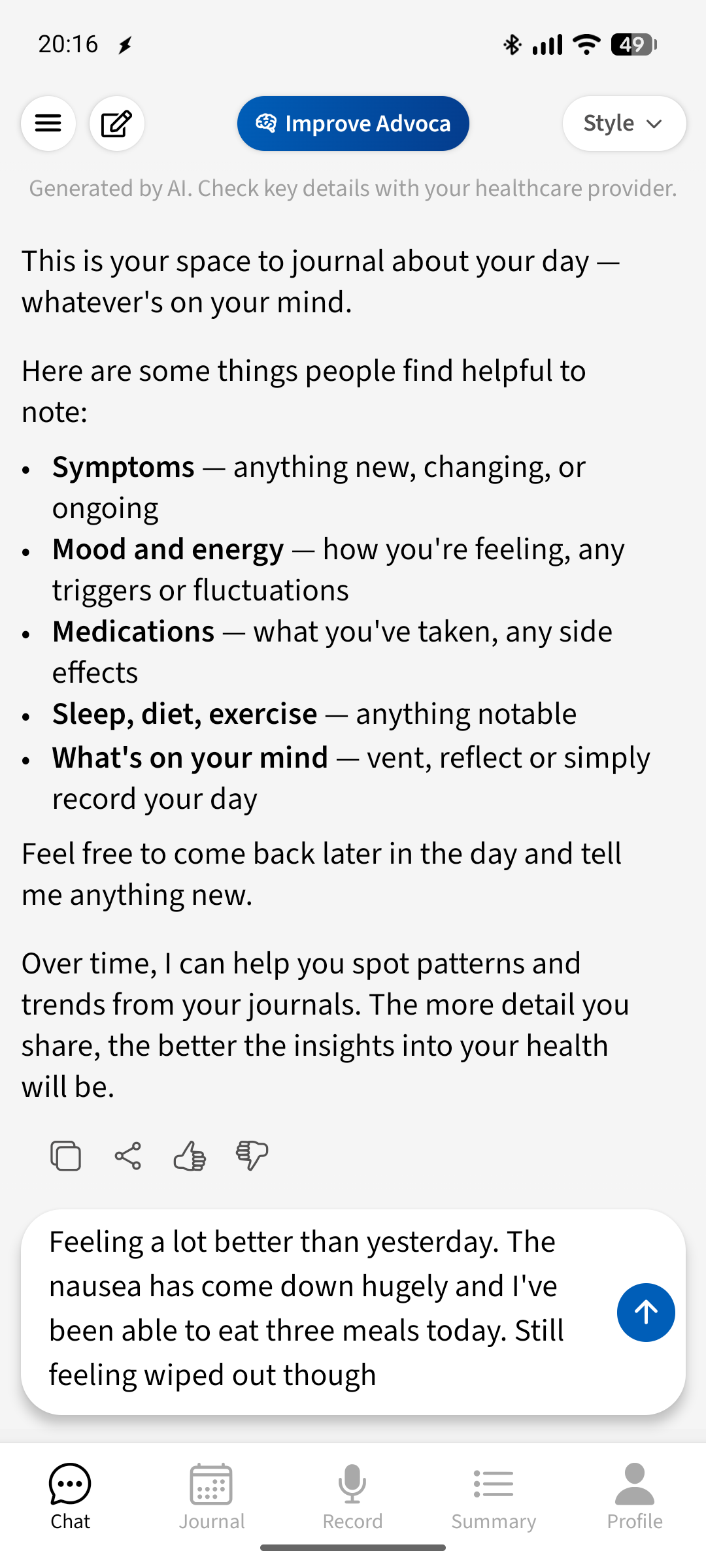
Advoca health journal entry describing chemo nausea improving and eating three meals
Journal your side effects

Track chemo side effects in your own words

Side effects between treatment cycles are largely invisible to your team unless you report them. With Advoca you don't fill in a rigid form. You just write your day the way it happened, by typing or chatting: "nausea improving today, ate three meals, fatigue in the afternoon". Over time you can ask what your entries show, like whether there's a pattern to your side effects this cycle, and get an answer drawn from your own words.

  • Write it your way. Capture side effects, symptoms, medications, energy, mood and appetite as they happen, by typing or chatting.
  • Ask your record a question, like "Is there a pattern to my side effects this cycle?", and get an answer from your own entries.
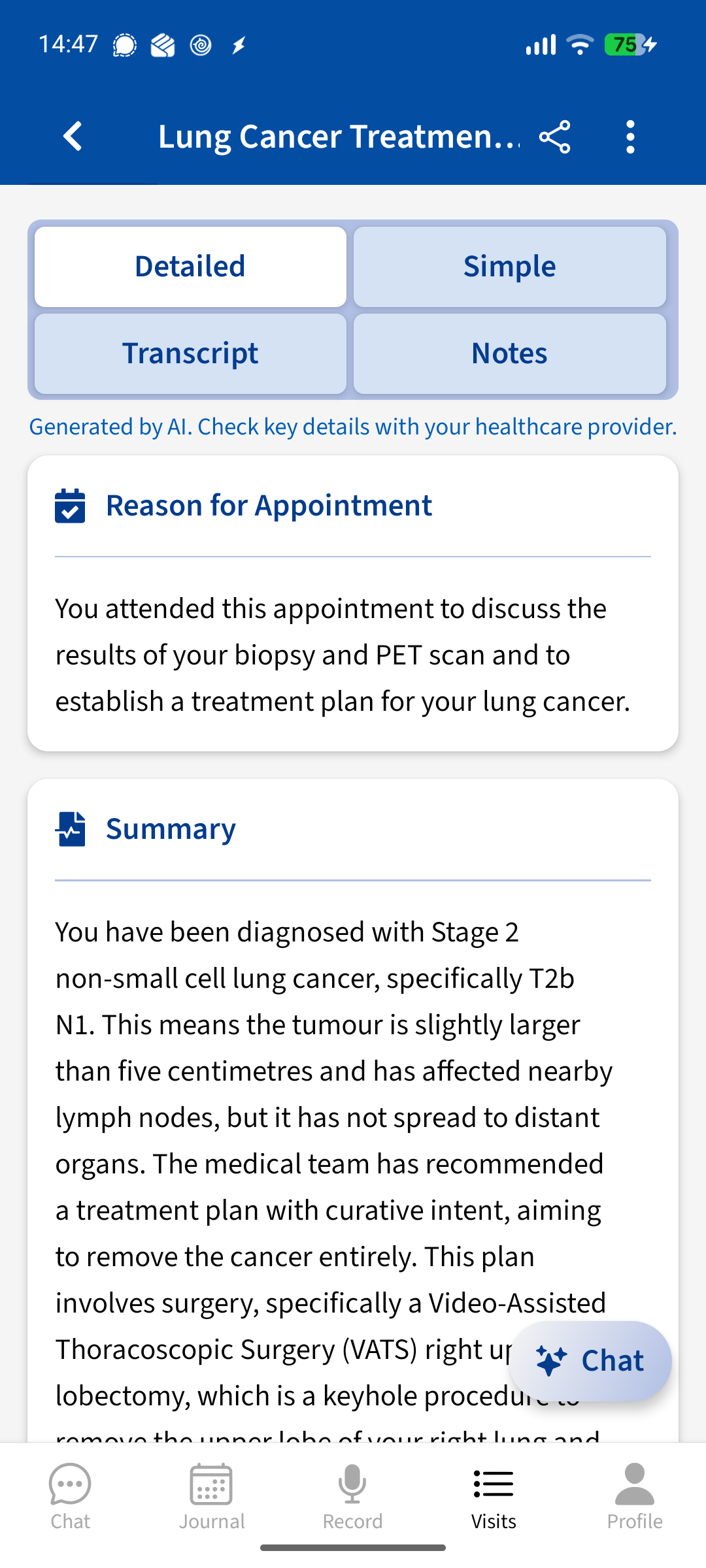
Advoca summary of a recorded lung cancer treatment appointment, covering biopsy, PET scan and VATS
Record your oncology consult

Record the appointment, get a summary you actually understand

An oncology appointment covers a lot in a short time: biopsy results, a scan for staging, the team's decision, and treatment options like adjuvant or neoadjuvant therapy. And the words don't always land the first time. Record it on your phone and Advoca turns it into a clear summary you can read at your own pace, with the full transcript saved alongside. Any medical term is explained in plain language, and if a dose or number looks off, it's flagged so you can check. Need it simpler? One tap gives you a plain-English version.

  • A clear summary, not a wall of notes. The key points and next steps, with the full transcript always there if you want it.
  • No more medical jargon. Terms are explained in plain language, and anything that looks like a wrong dose or number is flagged to check.
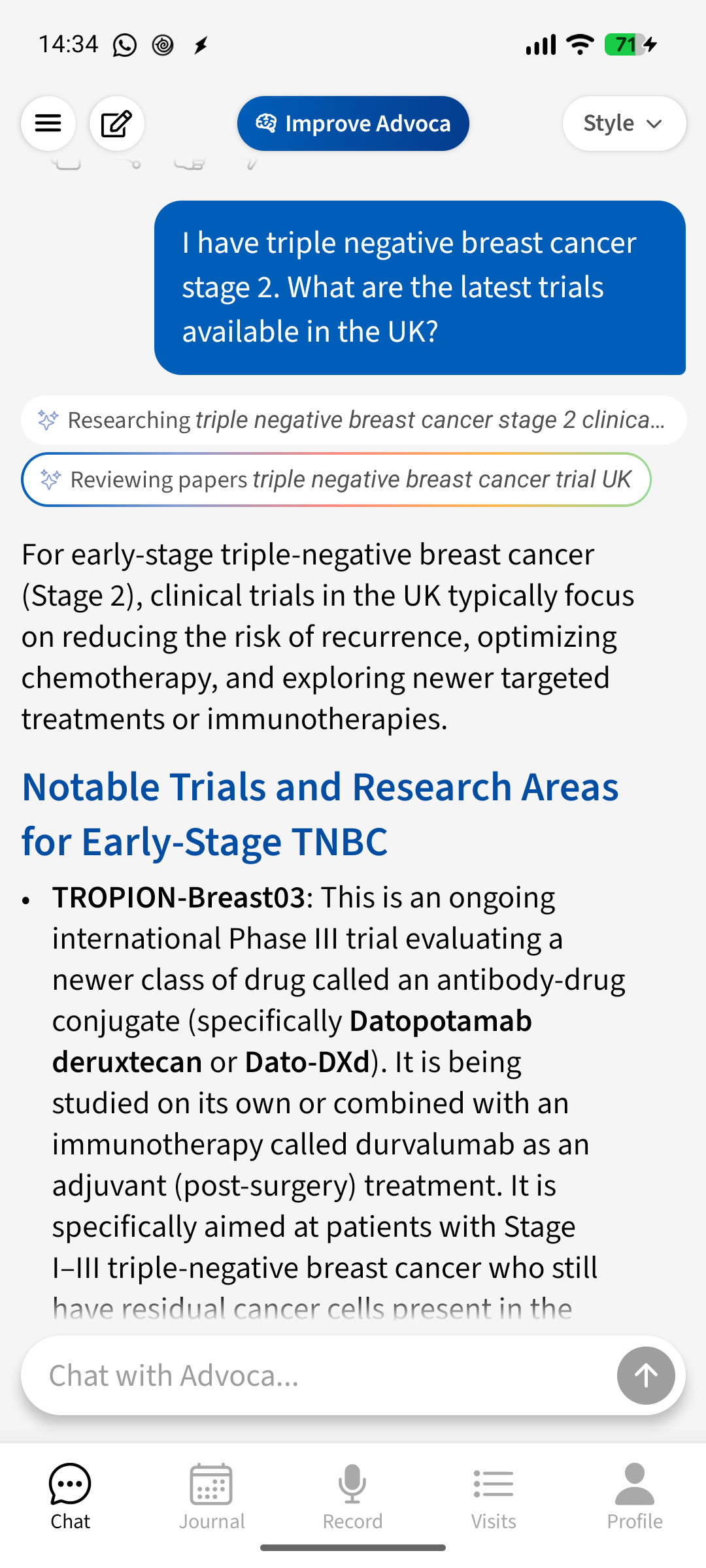
Advoca trusted-answers view showing triple-negative breast cancer, stage 2, UK clinical trials and TROPION
Ask your questions

Ask about your cancer or treatment, get clear answers

Wondering about the difference between chemotherapy and immunotherapy, whether your hair will fall out, or what a trial your oncologist mentioned actually involves? Just ask. Advoca answers from trusted charities, patient-information sites and medical sources (not the open web), and shows you where each answer came from so you can check for yourself. Answers are matched to your situation, so you're not shown information that could be distressing or doesn't apply to you. Think of it as a starting point for reading and a question to bring to your oncologist, not personal medical advice.

  • Answers from sources you can trust: charities, patient-information sites and medical bodies, not the open web.
  • See where it came from. Every answer shows its sources, so you can check for yourself.
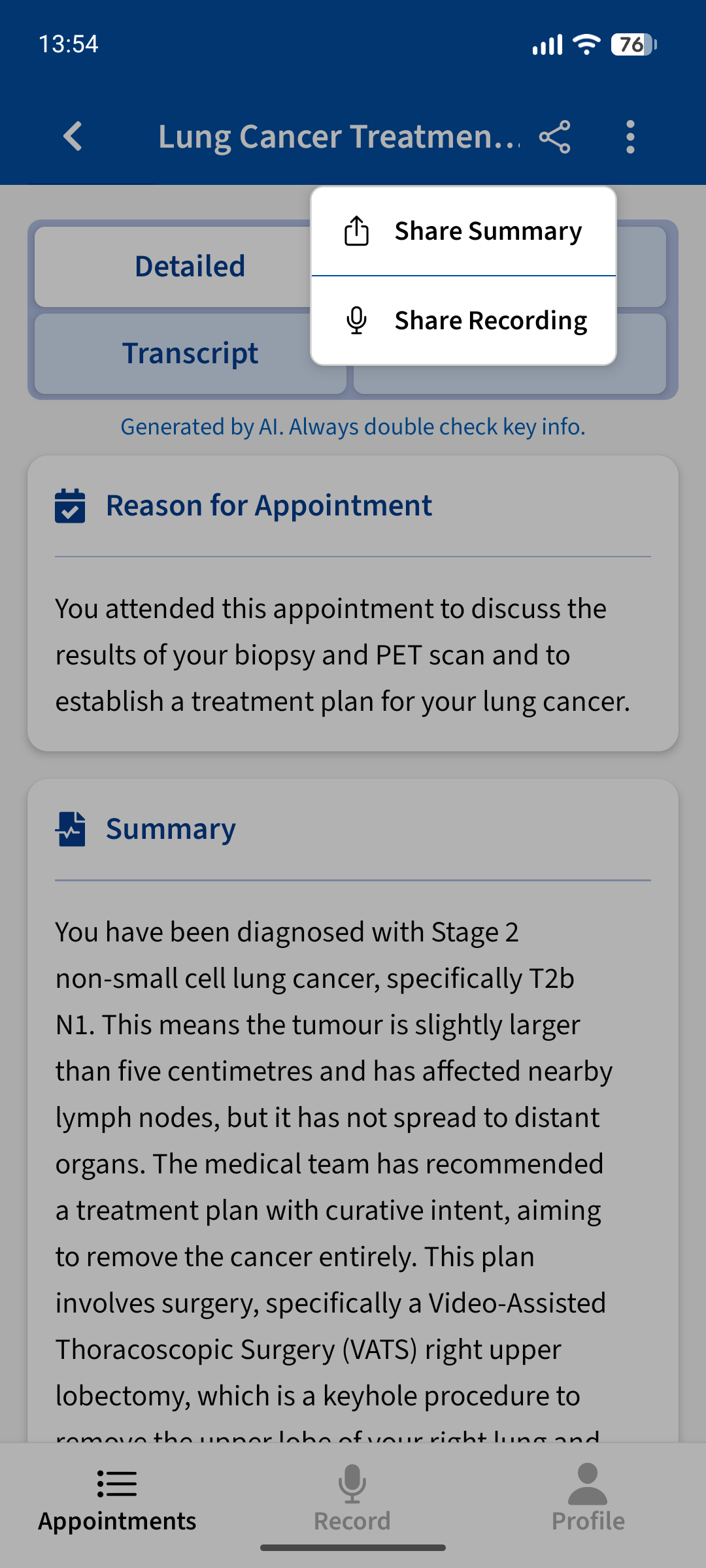
Advoca share-summary recording menu for a lung cancer treatment appointment
Stop repeating your story

Share a summary, arrive with a record

Cancer care means seeing an oncologist, a surgeon, a radiologist, a specialist nurse and your family doctor, and re-explaining a complex history at every stop. Advoca can pull together a summary from your recorded appointments, journals and plans, so you don't have to start from scratch each time. Share it with a partner or family member who couldn't be in the room, so they understand what was said and what happens next, without you having to relive it. Bring one to your next appointment, and the visit starts from a real record, not a vague memory.

  • Share with your carer. Send a summary of a recorded appointment so a partner or family member understands what was decided and what's next.
  • Never start from scratch. Advoca pulls together a summary or letter from your appointments and journals for your next visit or review.
HOW IT WORKS

From appointment to understood in three steps

  1. 1Journal your side effectsAs you go through treatment, write down what's happening: the nausea, the fatigue, the appetite, the mood. Type it or say it, in your own words. There's no form to fill in.
  2. 2Record and understand the consultRecord your oncology or doctor's appointment on your phone. Advoca turns it into a clear summary you can read at your own pace, with any medical term explained in plain language, and Simple mode if you need it.
  3. 3Arrive prepared next timeBefore the next visit, ask Advoca to draft a short list of what to cover, from your recent entries and last appointment. Share a summary with a carer or bring one with you, so the conversation starts from a real record, not a vague memory.
In their words

People living with cancer, using Advoca

I'm a doctor myself and have metastatic breast cancer. It's sometimes hard to retain information because of treatment, or memory, or because you're in shock from bad news. This means you don't miss a thing, and you have the time after the consult to go back over it, knowing you have the exact conversation at your fingertips.
— a doctor living with metastatic breast cancer
I recently got a recurrence of prostate cancer after an 11-year remission, and the shock and stress have been overwhelming. I've had brain overload with all the information bombarding me from the specialist and care team, and with the added stress my brain has been like a sieve. The app reminds me of upcoming appointments and prompts me to make notes to ask the consultant. It records the consultation, then gives you different levels of transcription, in depth or a basic layman's version, perfect if you've got an older relative who struggles with the jargon. It's going to be a game changer with my upcoming cancer consultations.
— living with recurrent prostate cancer
Reviewed by doctors

Built by doctors, grounded in evidence

Your data, protected

Your data is encrypted in transit and held on encrypted servers in the UK and EU, served over HTTPS. You don't need to share any identifying details to use Advoca, and appointment recordings stay on your own device — the audio is never uploaded to our servers.

Medical disclaimer

Advoca helps you record, understand and organise your care. It is not a substitute for professional medical advice, and it does not diagnose conditions or make treatment decisions — always speak to a qualified healthcare professional.

How the AI works

Advoca's assistant transcribes, summarises and explains your health information, grounded in trusted medical sources and overseen by our clinical team. It does not diagnose or replace your doctor — and, like any AI, it can occasionally get things wrong, so we always show you the sources and full transcript behind its answers.

Your questions, answered

What is cancer?

Cancer is not one disease but a large group of diseases that can affect almost any part of the body. Its defining feature is the rapid growth of abnormal cells that multiply beyond their usual boundaries, can invade neighbouring tissue, and may spread to other organs, a process called metastasis. A malignant tumour can spread; a benign tumour stays in one place and does not. Cancer becomes more common with age and is one of the leading causes of death worldwide. There are many types, including solid tumours such as breast, lung, bowel and prostate cancer and blood cancers such as leukaemia and lymphoma. Diagnosis is made by a doctor, usually confirmed with tests such as a biopsy or imaging. Sources: NHS, UK; NCI, US (NIH); WHO.

What's the best app for cancer?

The best cancer app depends on what you need it to do. Advoca is built for the whole cycle, not just side-effect logging: you journal side effects in plain language, record your oncology appointments and get a plain-language summary, ask grounded questions about your cancer or treatment, and arrive at follow-ups with a drafted agenda. The honest limitation: Advoca does not yet offer the symptom charts and trend graphs that some dedicated cancer logging apps have. Those are on the way. Its strength today is understanding what you write in your own words, and joining up your journal, your questions and your appointments in one place. Advoca does not diagnose cancer, stage it, give treatment advice, or replace your oncologist.

What are the signs and symptoms of cancer?

Cancer symptoms vary widely depending on the type, but some general signs are worth having checked by a doctor: a lump that appears or grows, unexplained weight loss, persistent fatigue, a change in bowel or bladder habits, a cough that will not go away, unusual bleeding, and a sore or mole that changes shape, size or colour. None of these mean you definitely have cancer, and many are caused by less serious conditions, but they are a reason to see your doctor so the cause can be found. Cancer is often more treatable when found early. Advoca does not diagnose cancer or interpret symptoms; it helps you record and track what you notice so you can describe it accurately at your appointment. Sources: NHS, UK; NCI, US (NIH); WHO.

How is cancer diagnosed?

Cancer is diagnosed by a doctor, not by an app. The process usually begins with your symptoms and an examination, followed by tests such as imaging (a CT, PET or MRI scan), blood tests, and a biopsy, where a small sample of tissue is taken and examined under a microscope to confirm whether cells are cancerous. If cancer is found, further tests work out how far it extends, called staging, often using the TNM system (tumour, node, metastasis). All of this, diagnosis and staging, is a clinical judgement made by your oncology team. Advoca does not diagnose cancer, stage it, or interpret scans, biopsies or lab results. It can record the conversation in which your results are explained so you understand and remember what was decided. Sources: NHS, UK; NCI, US (NIH); NICE, UK.

What causes cancer, and can it be prevented?

Cancer arises from the interaction of a person's genetic factors with external agents called carcinogens, which can be physical (such as radiation), chemical (such as tobacco smoke) or biological (such as certain infections). Tobacco use is the single largest risk factor, and around a quarter of cancer deaths are linked to tobacco, alcohol, high body weight, low fruit and vegetable intake, and lack of physical activity. According to the World Health Organization, approximately 38% of cancers can currently be prevented by avoiding risk factors and using existing evidence-based prevention strategies. Having a risk factor does not mean you will develop cancer, and many people with no clear risk factor still do. Advoca does not assess your personal risk or advise on prevention; for that, speak to your doctor. Sources: NHS, UK; NCI, US (NIH); WHO.

Can an app help with cancer?

An app can help you keep a record of your appointments, side effects and questions, and bring that record to your consultations. A systematic review of cancer patients found that a recording of your own consultation helps you recall what was said, beyond spoken information alone, and that a prepared list of questions helps too. That is the only claim that can be made: a record supports the consultation, your own understanding, and the review of your treatment. No app has been shown to improve cancer survival, prognosis or treatment response. Advoca goes further than a recording: it lets you journal side effects in plain language, summarise and explain your oncology appointments, ask grounded questions about your treatment, and draft a follow-up agenda. It does not diagnose cancer, give treatment advice, or replace your oncology team, and no app should be used to replace clinical care. Sources: NHS, UK; NCI, US (NIH); van der Meulen et al., 2008 (PubMed).

Become an expert on your own care.

Free to download, built by doctors, and private by design. Start in minutes.

Download free