Chronic Illness App
Advoca is a chronic illness app built by doctors. Journal your symptoms, energy, pain and sleep in your own words, record your specialist appointments, and carry a real record between every clinician on your team, so the conversation starts from evidence, not a vague memory.
Advoca showing your chronic illness record
Fibromyalgia and ME/CFS: long-term, fluctuating, and often invisible
A chronic illness is one that lasts months or years and is managed rather than cured. Fibromyalgia and ME/CFS (myalgic encephalomyelitis / chronic fatigue syndrome) sit in this group: long-term, fluctuating conditions defined by symptoms that come and go, and by the absence of a single tests-that-says-yes diagnosis. In everyday terms, they are conditions where pain, exhaustion, unrefreshing sleep and thinking difficulties ("brain fog") rise and fall, and much of that stays invisible to everyone but you.
The two overlap but are distinct. ME/CFS is marked by debilitating fatigue that rest does not fix, post-exertional malaise (a worsening after physical or mental activity), unrefreshing sleep and cognitive difficulties, and it can last for years and sometimes lead to serious disability. Fibromyalgia's hallmark is widespread, long-lasting pain and tenderness, often alongside fatigue, sleep problems and "fibro-fog". Both are more common in women, frequently co-occur with each other and with irritable bowel or mood difficulties, and tend to come on after a viral illness, a stressful event, or slowly and without a clear trigger.
Day-to-day, these conditions are hard to hold onto. Symptoms fluctuate, the only person who sees the full pattern is you, and brain fog makes even the last appointment hard to recall. People commonly see several specialists over years, re-explaining a complex story at each one, and NICE itself notes that people with ME/CFS may have experienced prejudice and disbelief. So a record kept between visits, by the person living it, matters.
More than 9 in 10 people with ME/CFS have not been diagnosed, so most are navigating a fluctuating, invisible illness without it being formally recognised.
Chronic illness happens between appointments, and memory isn't enough
Most of your chronic-illness life happens out of a clinician's sight. A flare on Tuesday, the crash after a short walk, the unrefreshing sleep, the bad week you can't explain: by the time you reach a short follow-up, the detail has blurred under brain fog. Triggers go unexamined, side effects go unmentioned, and the appointment moves on before you've remembered what you meant to ask. Then there's the jargon, post-exertional malaise, pacing, hyperalgesia, and the cycle of re-explaining your whole story to each new specialist, often someone who knows less about your condition than you.
Keeping a record changes the picture.
Keeping a record changes that. International guidance frames the self-management of long-term conditions as led by the person themselves, and a record of your symptoms, energy, sleep and medication use is most useful at the point of consultation, when you bring it to a time-pressed clinician. Advoca was built so that record is easy to keep and genuinely useful in the room: you journal in plain language as it happens, record your appointments so nothing is lost, and walk in with a real summary instead of a vague memory. Nothing here diagnoses fibromyalgia or ME/CFS, or replaces your doctor. It gives you and your clinician something solid to look at together.
How Advoca helps with chronic illness
[ Phone mockup ]
Track flares, crashes and symptoms in your own words
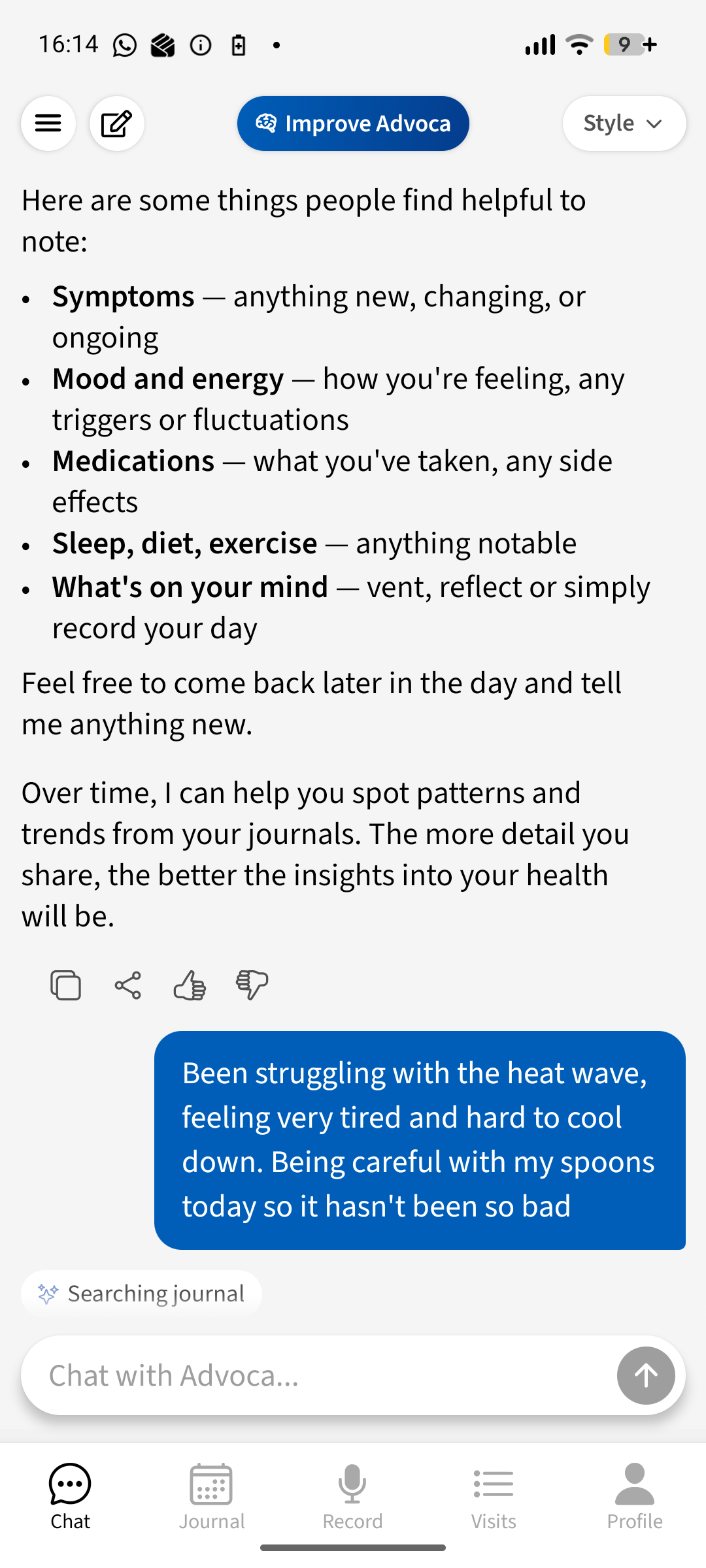
Fibromyalgia and ME/CFS are defined by their variability: good days and bad, flares and crashes, and what sets them off. The biggest help is a record that captures that reality as it happens, in your own words. With Advoca you don't fill in a rigid form. You write your day: "slept badly, brain fog all morning, crashed after walking the dog, widespread pain all afternoon, 6 out of 10". Over time you can ask what your entries show, like whether there's a pattern to your bad weeks, and get an answer drawn from your own words.
- Write it your way. Capture pain, energy, sleep and brain fog as they happen, by typing or chatting. No form to fill in.
- Ask your record a question, like "Is there a pattern to my bad weeks this month?", and get an answer from your own entries.
[ Phone mockup ]
Record the appointment, get a summary you can actually understand
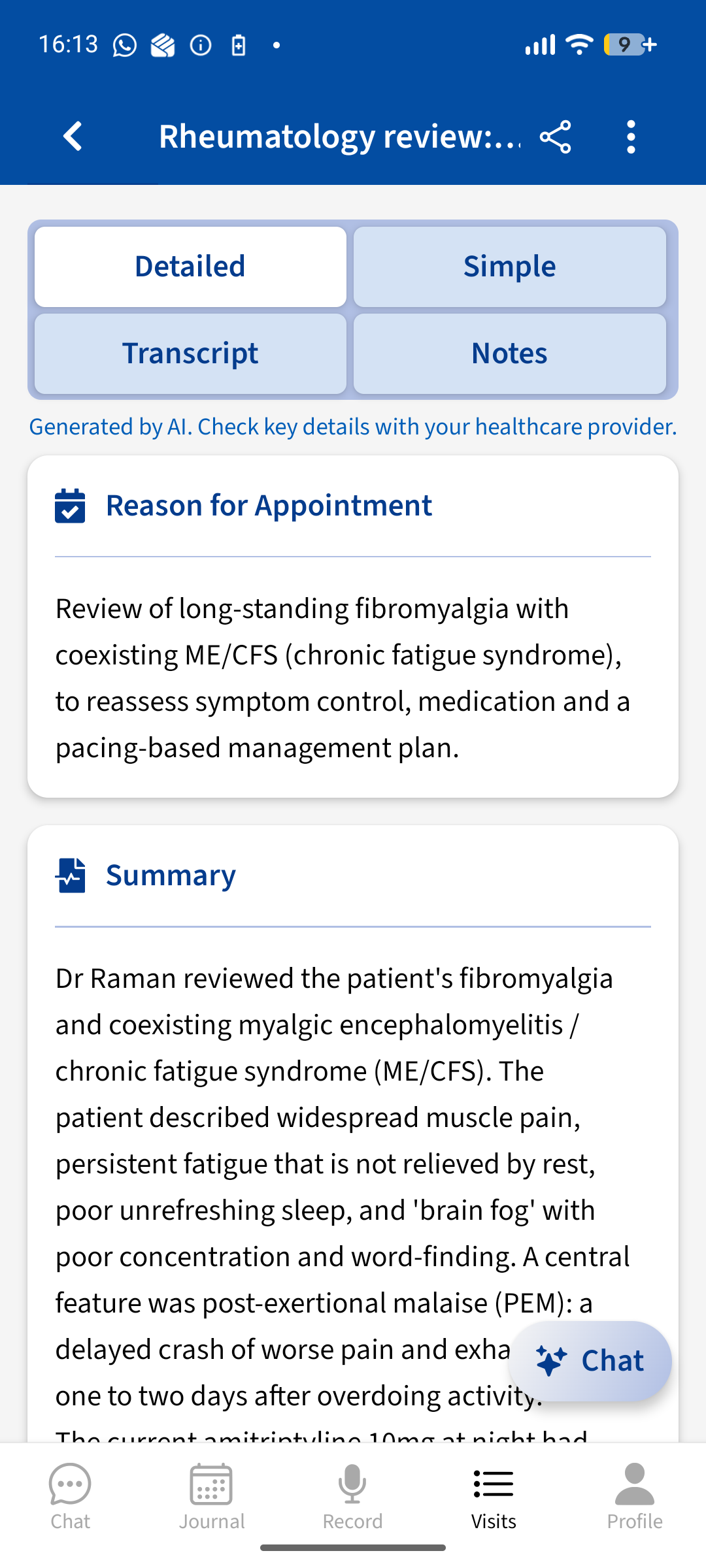
A rheumatology, fatigue-clinic or pain-management appointment covers a lot in fifteen minutes, and brain fog makes recall near impossible. The biggest help is walking out with a record you can reread at your own pace. Record it on your phone and Advoca turns it into a clear summary: the key points, next steps and results, with the full transcript saved alongside. Any medical term, like post-exertional malaise, is explained in plain language, and if a dose or number looks off, it's flagged so you can check.
- A clear summary, not a wall of notes. The key points and next steps, with the full transcript always there if you want it.
- No more jargon. Terms like post-exertional malaise are explained in plain language, and anything that looks like a wrong dose or number is flagged to check.
[ Phone mockup ]
Ask about your condition, get clear answers
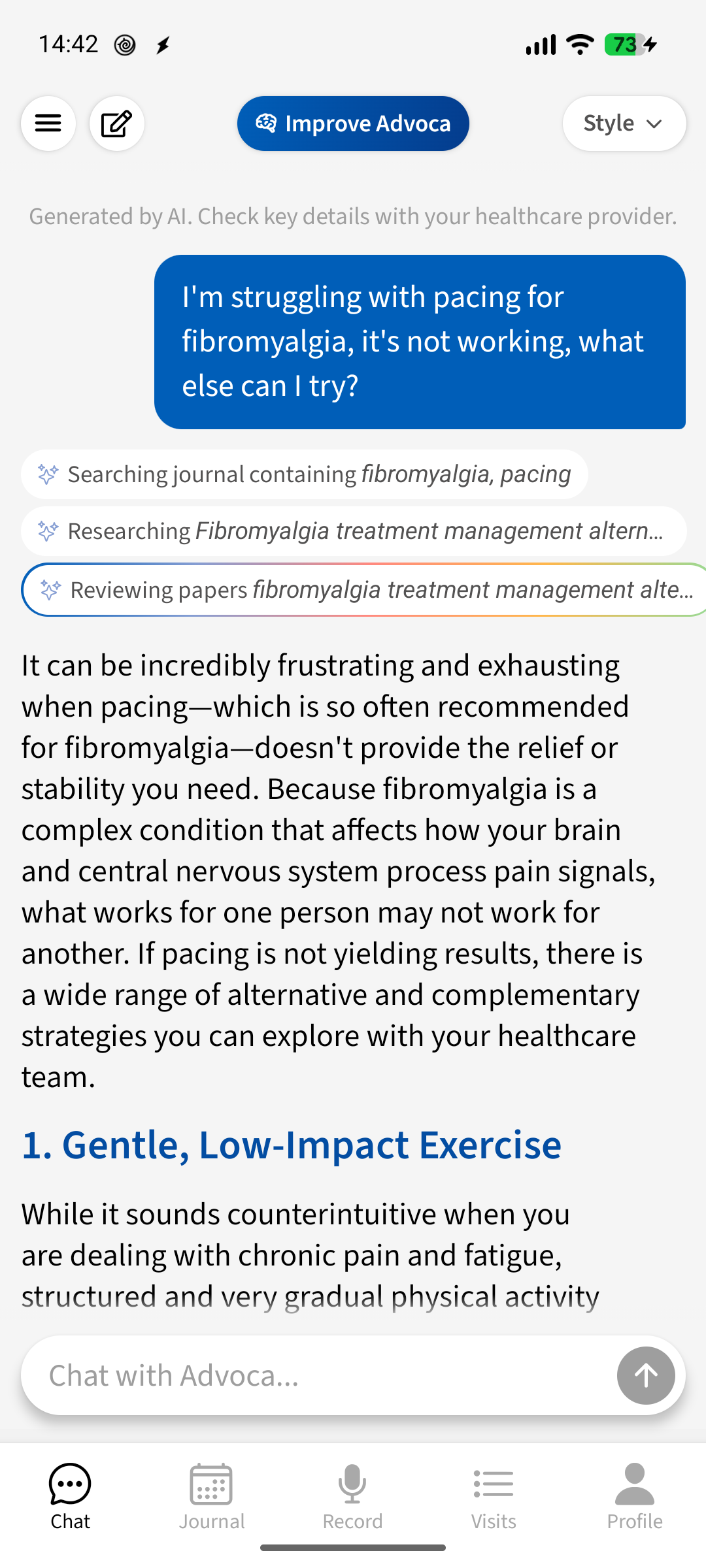
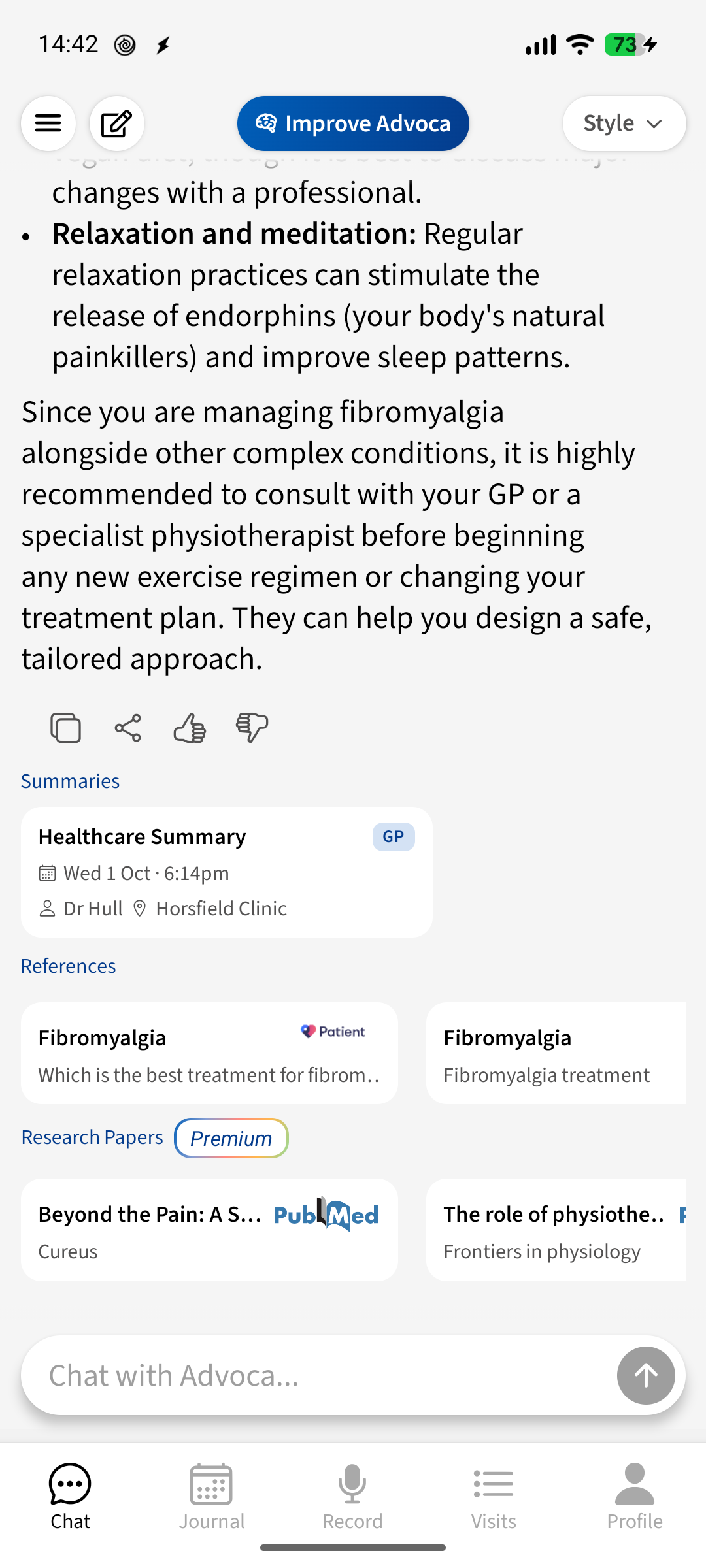
When you're told a term or a treatment option you don't recognise, the open web is a minefield of single-country and miracle-cure answers. The biggest help is a clear answer you can trust. Just ask things like "What is post-exertional malaise?", "Why doesn't rest fix the fatigue in ME/CFS?" or "What's the difference between fibromyalgia and ME/CFS?". Advoca answers from trusted charities, patient-information sites and medical sources, and shows you where each answer came from. Think of it as a starting point for reading and a question for your doctor, not personal advice.
- Answers from sources you can trust: charities, patient-information sites and medical bodies, not the open web.
- See where it came from. Every answer shows its sources, so you can check for yourself.
[ Phone mockup ]
Arrive at every appointment with a record and a plan
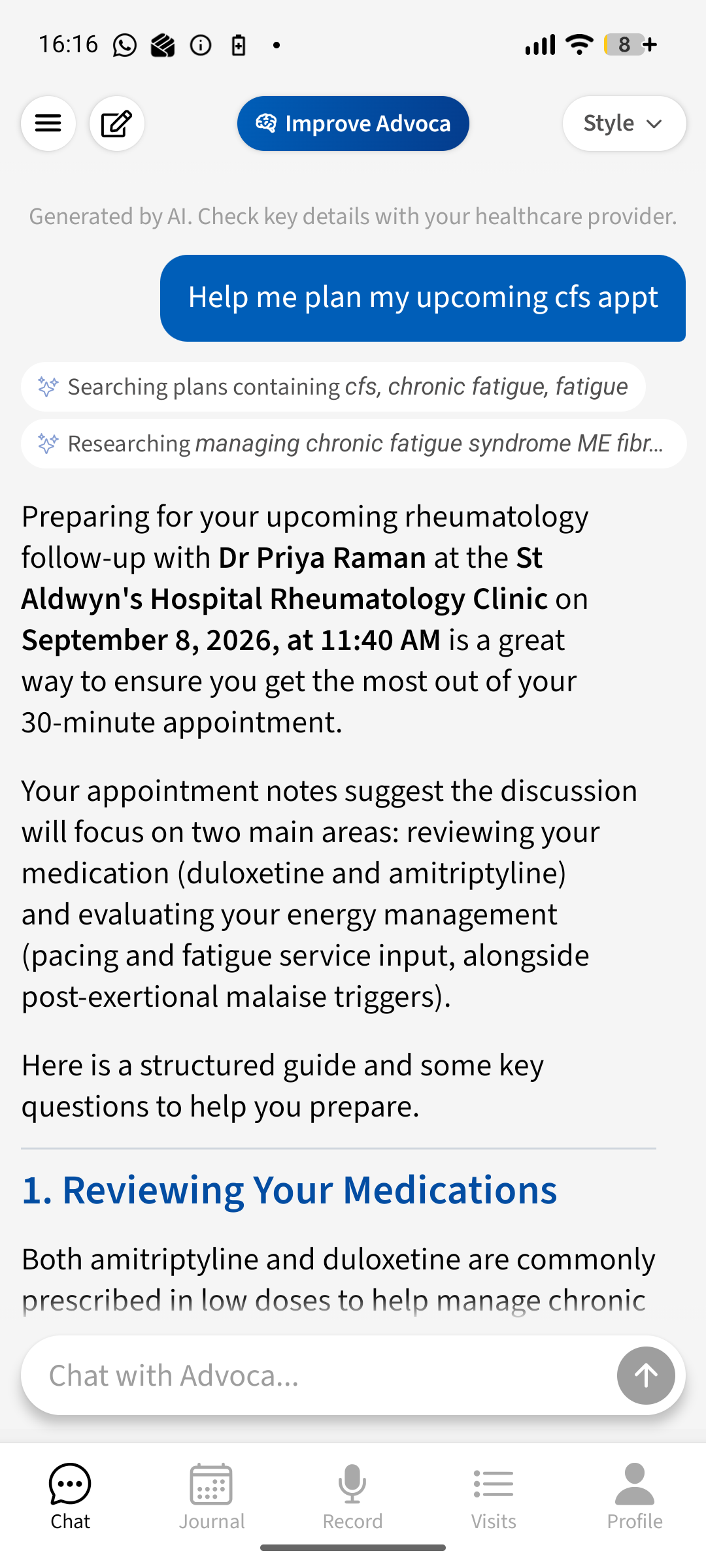
Chronic illness means cycling through multiple clinicians, re-explaining a years-long story at every stop, often to someone who knows less about your condition than you do. The biggest help is never starting from scratch again. Before a visit, jot down what you want to cover. Advoca can draft a short list from your recent entries and last appointment, like "fatigue clinic, pacing review, sleep, whether to try a medication like duloxetine". Those notes appear the moment you start recording, and you can share a summary of a past visit with a carer or bring one to your next specialist.
- Go in with a plan. Advoca drafts a short list of what to cover, from your recent entries and last visit.
- Carry your story with you. Share a summary of a past visit with a carer or bring one to your next specialist, so the conversation starts from a real record.
From flare to understood in three steps
- 1Journal the dayWhen a flare or crash hits, just write what happened: the pain, your energy, the sleep, the brain fog, what you think set it off, the medication you took. Type it or say it. There's no form to fill in.
- 2Record and understand the consultRecord your rheumatology, fatigue-clinic or doctor's appointment on your phone. Advoca turns it into a clear summary you can read at your own pace, with any medical term explained in plain language.
- 3Arrive prepared next timeBefore the next visit, ask Advoca to draft a short list of what to cover, from your recent entries and last appointment. Share a summary with a carer or your clinician, so the conversation starts from a real record, not a vague memory.
When the story finally makes sense
This app has been acting almost like a virtual counsellor as it's piecing together my medical journey and explaining it in a way that no other doctor has… Knowing this is helping me to process and understand the trauma I have felt from not understanding or knowing truly what had happened.
Built by doctors, grounded in evidence
This page was written by Dr Shyam Dhokia (MB BChir, Cambridge) and medically reviewed by Dr Michael Trueman (MB ChB, Birmingham), both former NHS doctors and the co-founders of Advoca. It was last reviewed on 8 July 2026 and is kept current as clinical guidance and app features change.
- NICE, "Myalgic encephalomyelitis (or encephalopathy)/chronic fatigue syndrome: diagnosis and management" (NG206) — the four core symptoms of ME/CFS (debilitating fatigue worsened by activity, post-exertional malaise, unrefreshing sleep, cognitive difficulties), energy management as a self-management strategy "led by the person themselves," and the note that people with ME/CFS "may have experienced prejudice and disbelief."
- CDC, "About ME/CFS" — "Up to 3.3 million people in the United States" have ME/CFS; "More than 9 in 10 people with ME/CFS have not been diagnosed"; post-exertional malaise (PEM) defined as a worsening after physical or mental activity; ME/CFS "can last for years and sometimes leads to serious disability."
- WHO, "Noncommunicable diseases" — chronic (noncommunicable) diseases "tend to be of long duration" and require ongoing management (detection, treatment and care), the structural reason a longitudinal record has value across any chronic-illness cohort.
- NHS, "Fibromyalgia" — a "long-term condition that causes pain all over the body"; "nearly 1 in 20 people may be affected by fibromyalgia"; more common in women, typically develops between 25 and 55; no cure, managed.
- MedlinePlus, "Fibromyalgia" (US National Library of Medicine, NIH) — a chronic condition of widespread pain all over the body and fatigue, with women about twice as likely to be affected; no cure, focused on managing symptoms.
Your data is encrypted in transit and held on encrypted servers in the UK and EU, served over HTTPS. You don't need to share any identifying details to use Advoca, and appointment recordings stay on your own device — the audio is never uploaded to our servers.
Advoca helps you record, understand and organise your care. It is not a substitute for professional medical advice, and it does not diagnose conditions or make treatment decisions — always speak to a qualified healthcare professional.
Advoca's assistant transcribes, summarises and explains your health information, grounded in trusted medical sources and overseen by our clinical team. It does not diagnose or replace your doctor — and, like any AI, it can occasionally get things wrong, so we always show you the sources and full transcript behind its answers.
Your questions, answered
What is a chronic illness?
A chronic (long-term) illness is one that develops and continues over months or years and is managed rather than cured. Fibromyalgia, ME/CFS, migraine and many others fall in this group. The World Health Organization describes chronic diseases as tending to be of long duration and needing ongoing management. They often fluctuate, and much of their impact is invisible between appointments. Sources: WHO; NHS, UK (fibromyalgia as a long-term condition); CDC, US (ME/CFS as a chronic, long-term condition).
What are fibromyalgia and ME/CFS, and how do they differ?
Fibromyalgia's hallmark is widespread, long-lasting pain and tenderness, often with fatigue, unrefreshing sleep and problems with thinking ("fibro-fog"). ME/CFS (myalgic encephalomyelitis / chronic fatigue syndrome) is marked by debilitating fatigue that rest does not fix, post-exertional malaise (a worsening after physical or mental activity), unrefreshing sleep and cognitive difficulties ("brain fog"). The key difference is the symptom that defines each: widespread pain in fibromyalgia, and post-exertional malaise plus fatigue that rest does not fix in ME/CFS. The two often co-occur, and both are managed rather than cured. Sources: NHS, UK (fibromyalgia); CDC, US (ME/CFS); NICE NG206, UK (ME/CFS).
What is post-exertional malaise (PEM)?
Post-exertional malaise (PEM) is the hallmark symptom of ME/CFS: a worsening of symptoms after physical or mental activity that would normally be tolerated. It can be delayed, last for hours or days, and is different from ordinary tiredness. The US CDC defines PEM as symptoms getting worse after any activity, and NICE lists it as a core feature of ME/CFS alongside debilitating fatigue worsened by activity, unrefreshing sleep and cognitive difficulties. PEM is central to why energy management (pacing) matters in ME/CFS, and NICE is clear that this kind of management is led by the person themselves, not prescribed by the app. Sources: CDC, US; NICE NG206, UK.
What's the best app for chronic illness?
The best app depends on what you need it to do. Advoca is built for the whole cycle, not just symptom logging: you journal symptoms, energy, pain and sleep in plain language, record your specialist appointments and get a plain-language summary, ask grounded questions about your condition, and arrive at follow-ups with a drafted agenda. The honest limitation: Advoca does not yet offer the symptom charts and trend graphs that some dedicated trackers have. Those are on the way. Its strength today is understanding what you write in your own words, and joining up your journal, your questions and your appointments in one place. Advoca does not diagnose fibromyalgia or ME/CFS, and it does not replace your doctor.
Is there a cure for fibromyalgia or ME/CFS?
There is currently no cure for either. Both are long-term conditions managed day to day. The NHS describes fibromyalgia as a long-term condition with no cure, managed with symptom-focused treatment and self-management, and NICE frames ME/CFS management as patient-led, including energy management (pacing), rest and activity adjusted to each person's tolerance. Medications and approaches, for example a medication like duloxetine, are recognised options for context only; naming them is not a recommendation. Treatment decisions are always for you and your clinician. Sources: NHS, UK (fibromyalgia); NICE NG206, UK (ME/CFS); MedlinePlus, US (fibromyalgia).
Can an app help with a chronic illness?
An app can help you keep a record of your symptoms, energy, pain, sleep and medication use, and bring that record to your consultations. International guidance frames the self-management of long-term conditions as led by the person themselves. Because these conditions fluctuate and are largely invisible, the only person who sees the full pattern between appointments is you, and a record kept over time helps you and your doctor review treatment and make sense of changes. Advoca goes further than a diary: it lets you journal in plain language, record and summarise your appointments, ask grounded questions, and draft a follow-up agenda. It does not diagnose, give personal treatment advice, or replace your doctor, and no app should be used to replace clinical care. Sources: WHO; NICE NG206, UK; CDC, US.
Explore related conditions and features
Advoca can support you across other long-term conditions, and the features that help you manage them.
Migraine
Track attacks, possible triggers and the medications that help, and bring a real record to your neurology reviews.
Learn more →Rare disease
Keep a detailed, searchable record through a long and complex diagnostic journey across specialists.
Learn more →Cancer
Record consultations, understand medical terms, and keep every scan and next step in one place.
Learn more →Become an expert on your own care.
Free to download, built by doctors, and private by design. Start in minutes.